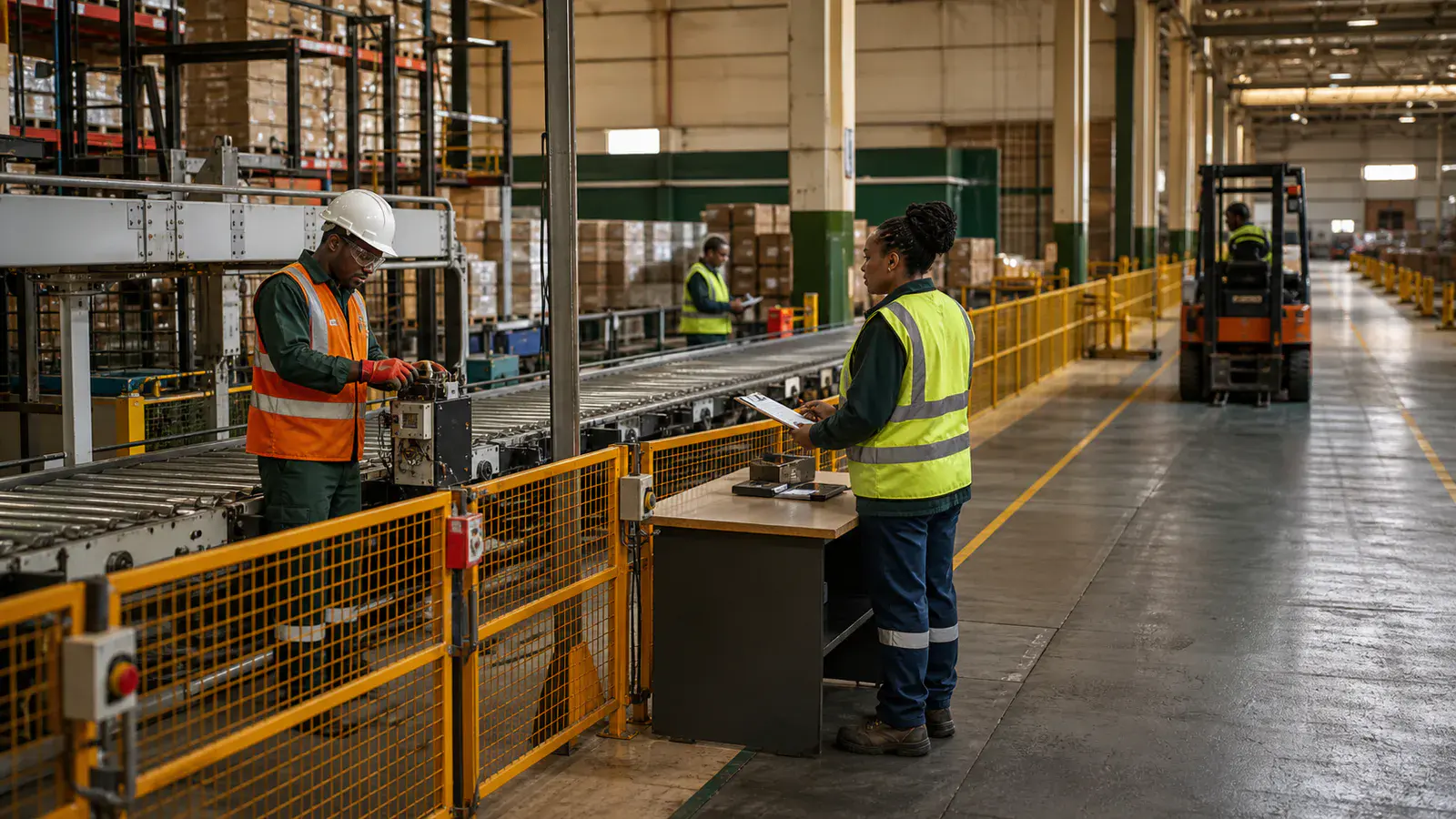
A first job in a warehouse, workshop or maintenance team can look like a temporary stop. Sometimes it is. It can also be the first rung of a career ladder—if you learn what the next rung requires before you get stuck doing the same task for years.
This matters in Gauteng, where distribution centres, factories, vehicle fleets, offices, hospitals, shopping centres and public facilities depend on people who keep equipment working and goods moving.
That is a signal, not a promise. The useful question is not, "Which job is guaranteed?" It is, "Which operating system can I learn well enough to become more valuable over time?"
Three ladders worth mapping
The 2024 National List of Occupations in High Demand includes roles such as electrician, plumber, solar installer, fitter and turner, diesel mechanic, maintenance planner, forklift driver, truck driver, supply-chain practitioner and warehouse, fleet and logistics managers. These occupations do not share one education route.
A practical maintenance ladder might look like this:
- Maintenance assistant or workshop helper.
- Apprentice or trainee in a recognised trade.
- Qualified artisan, such as an electrician, fitter, millwright or diesel mechanic.
- Senior artisan, team leader or field-service technician.
- Maintenance planner, facilities coordinator or supervisor.
The early job gives you exposure, but exposure alone does not make you qualified. Regulated and safety-critical work may require formal training, supervised experience, assessment, certification or registration. Never present yourself as authorised to perform electrical, lifting, mechanical or other hazardous work when you are not.
A logistics ladder may start differently:
- Picker, packer, receiving assistant or dispatch assistant.
- Forklift operator, inventory clerk, route assistant or controller.
- Dispatch coordinator, stock controller or clearing-and-forwarding assistant.
- Supply-chain practitioner or warehouse supervisor.
- Warehouse, fleet, road-transport or logistics manager.
Moving up this ladder usually means becoming reliable with more than physical movement. You begin to understand stock accuracy, paperwork, scanning systems, scheduling, safety, damaged goods, delivery exceptions and communication between drivers, customers and the warehouse.
A third route connects the two. A vehicle assistant might develop towards diesel mechanics or fleet maintenance. A warehouse worker who understands equipment downtime might move towards maintenance planning. A solar installation assistant could pursue a recognised technical qualification and supervised workplace learning.
Do not choose only by the first job title. Choose the system you are willing to understand.
Turn an entry job into a learning position
Before accepting training or paying a provider, write down the destination occupation and check its usual qualification pathway. Confirm that the institution and programme are appropriately recognised. A course called forklift expert or solar engineer on social media may sound impressive while carrying little value with employers.
Then ask five questions at work:
- Which errors cost this team the most time or money?
- Which machines, documents or software does the next-level employee use?
- What safety rules are non-negotiable?
- Who trains or assesses people for the next role?
- What evidence would show that I am ready for more responsibility?
Keep a private learning log that does not expose company information. Record equipment you were trained to use, safety briefings completed, processes learned, improvements suggested and positive feedback received. Where possible, obtain legitimate certificates, supervisor confirmations or assessed results.
Do not wait for a promotion before learning an adjacent task. If your supervisor agrees, ask to observe a stock count, help prepare a maintenance schedule, learn how delivery exceptions are logged or shadow a qualified artisan. Ten small, authorised exposures can tell you more about a pathway than one expensive course chosen blindly.
Use sideways moves deliberately
Career ladders are rarely perfectly vertical. A picker may become a receiving clerk before becoming a controller. A workshop assistant may move to a larger employer to find an apprenticeship. A driver may shift into dispatch because the long-term goal is fleet coordination.
Judge a sideways move by what it adds:
- A recognised skill or qualification.
- Experience with better systems or equipment.
- Safer and more structured supervision.
- Evidence you can show a future employer.
- Access to the next realistic role.
Higher demand does not mean immediate vacancies, high pay or easy entry. Geography, licences, experience, shift patterns and employer budgets still matter. Compare the official occupation signal with current Gauteng adverts, speak to people already doing the work and calculate the real cost of transport and training.
The strongest career ladder is not the one with the fanciest title. It is the one where each step leaves you with more verified capability than the step before.
Sources and limits
- The DHET 2024 National List of Occupations in High Demand is a national planning signal, not a vacancy list.
- DHET labour-market research and planning resources explain how the department uses demand research for skills planning.
- The Gauteng government economic sectors overview identifies automotive, transport, logistics, infrastructure and alternative energy among provincial priorities.
Qualification, licensing and safety requirements must be confirmed with the relevant authority, accredited provider and employer.