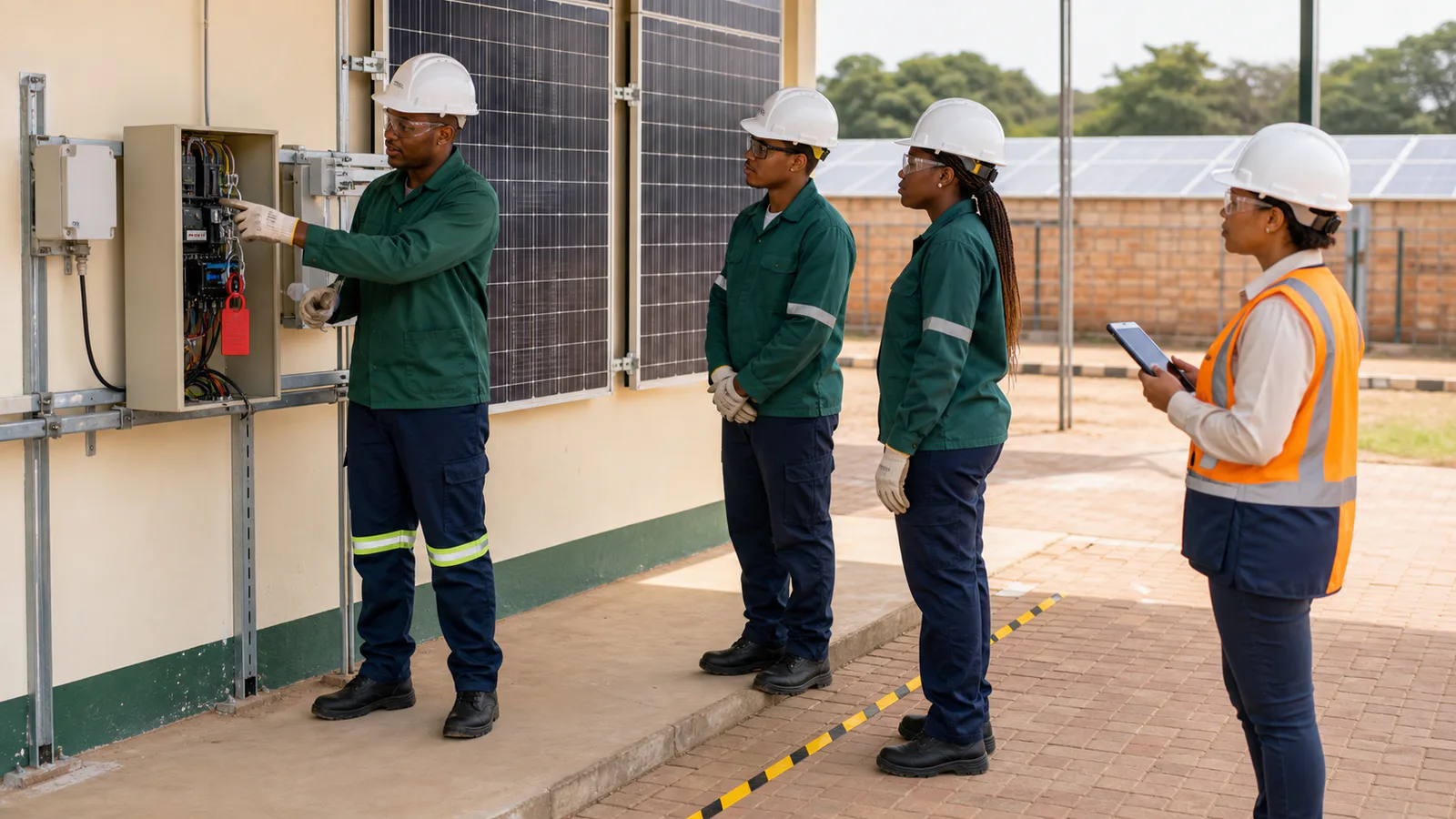
Green work is not limited to people with "environmental" in their title. The energy transition also needs technicians, tradespeople, operators, safety practitioners, planners, administrators and customer-facing staff.
A solar project involves more than designing panels. Someone assesses the site, coordinates equipment, completes authorised installation work, checks safety, schedules maintenance, tracks costs, supports customers and handles records.
This wider view creates more options, but it does not remove qualification or safety requirements.
Look beyond the headline job
South Africa's 2024 National List of Occupations in High Demand includes roles such as Solar Installer, Electrician, Energy Efficiency Technician, Water Process Controller and Safety, Health, Environment and Quality Practitioner. The listed indicative qualification levels differ by occupation.
That is a useful local signal—not proof that every role has abundant Gauteng vacancies.
U.S. projections place wind-turbine technicians and solar photovoltaic installers among the fastest-growing occupations by percentage. The same projections show why percentages require care: those occupations start from a relatively small employment base. American growth is not a forecast for South Africa.
Instead of asking which green title is best, choose the type of contribution that fits you.
Route one: build and install
This route suits people who enjoy practical work, tools, sites and visible results. Relevant work may include electrical installation, solar installation, mechanical fitting, construction or commissioning support.
These jobs can involve heights, heat, travel and strict safety procedures. Never perform electrical work, climb equipment or imitate an installation as a portfolio exercise unless you are properly trained, supervised and authorised.
A safe first step is to examine approved training routes, visit a legitimate information session and speak to a qualified worker about daily conditions.
Route two: operate and maintain
New equipment creates an ongoing need for inspection, fault reporting, planned maintenance, inventory and performance monitoring.
People in this lane may work with facilities, energy systems, water processes, manufacturing equipment or fleets. Useful foundations include technical reading, maintenance records, spreadsheets, basic measurement and disciplined safety habits.
A safe work sample could be a mock preventive-maintenance schedule based on a manufacturer's public documentation. Make it clear that it is a learning exercise, not an approved procedure for live equipment.
Route three: measure, assure and improve
Organisations need people who can track energy use, environmental performance, quality and compliance. Possible work includes energy-efficiency support, water-quality monitoring, environmental analysis and SHEQ administration.
This lane suits people who notice inconsistencies, enjoy records and can explain why a requirement matters. A beginner project could analyse an invented facility's monthly energy use, identify unusual patterns and list the additional information needed before recommending action.
Do not turn a simple spreadsheet into an engineering claim. Good analysis is honest about what cannot be concluded.
Route four: coordinate and serve
Green projects also need procurement, scheduling, project administration, sales support and customer education. These roles may not always be advertised as green jobs. The employer's product or project creates the green context.
A project coordinator might track deadlines and permits. A supply-chain assistant might monitor component availability. A customer-support worker might explain maintenance appointments without making technical promises.
Search by both occupation and sector. Combine terms such as project administrator, maintenance planner or customer support with solar, energy, water, facilities or environmental services.
Run a six-week exploration
During week one, collect 20 recent adverts in Gauteng. Separate qualified technical work from commercial and administrative support.
In week two, choose one lane and identify the three most repeated requirements.
In weeks three and four, create one safe work sample: a stock tracker, project schedule, maintenance-record template or energy-use analysis using invented data.
In week five, speak to a worker or training provider. Ask about working conditions, entry requirements and the mistakes beginners make.
In week six, decide whether to pursue formal training, an adjacent role or a second experiment.
Before paying a provider, ask:
- Is the institution and programme appropriately accredited or recognised?
- What qualification or occupational outcome does it lead to?
- What is the complete cost?
- Is workplace-based learning included, and who provides it?
- Which safety training is required?
- Can the provider support its placement claims with clear evidence?
South Africa's green transition could create valuable work, but emerging sectors also carry uncertainty. Projects can be delayed and technologies can change. DHET's hydrogen research, in particular, identifies specialised workplace-learning gaps; that finding should not be assumed to describe every green sector.
A practical candidate prepares for a family of useful tasks, not one fashionable title.
Sources and limits
- The DHET 2024 National List of Occupations in High Demand provides local signals and indicative minimum qualification levels, not vacancy guarantees.
- DHET's 2024 research on skills for South Africa's hydrogen economy discusses a developing sector with skills and workplace-learning gaps.
- The U.S. BLS 2024–2034 projections release applies to the United States.
- The World Economic Forum Future of Jobs 2025 outlook is a global employer survey, not a South African hiring forecast.